Is Herringbone Engineered Wood Flooring Worth It and Can You Actually Get It Cheap?
There’s a version of this question that every homeowner, when planning for a renovation, keeps on asking on every forum, ranging from every Facebook group to Instagram channels to every kitchen table conversation where someone has just started planning a renovation. It goes something like this: “I love the look of herringbone flooring, but isn’t it costly?”
The short answer is no; these days, it’s not expensive anymore. But the detailed answer is more intriguing and, honestly, more useful. Because the real question isn’t just about price. It’s about understanding what you’re actually buying, what separates good, affordable and cheap engineered flooring from bad engineered flooring, and whether herringbone is genuinely the right choice for your home or just something that looks beautiful on someone else’s Instagram.
Let’s explore the details, and you’ll have a better understanding by the end of the article. Let’s begin by understanding what actually makes the herringbone engineered wood flooring different from all other floors.
What Actually Makes Herringbone Engineered Wood Flooring Different?
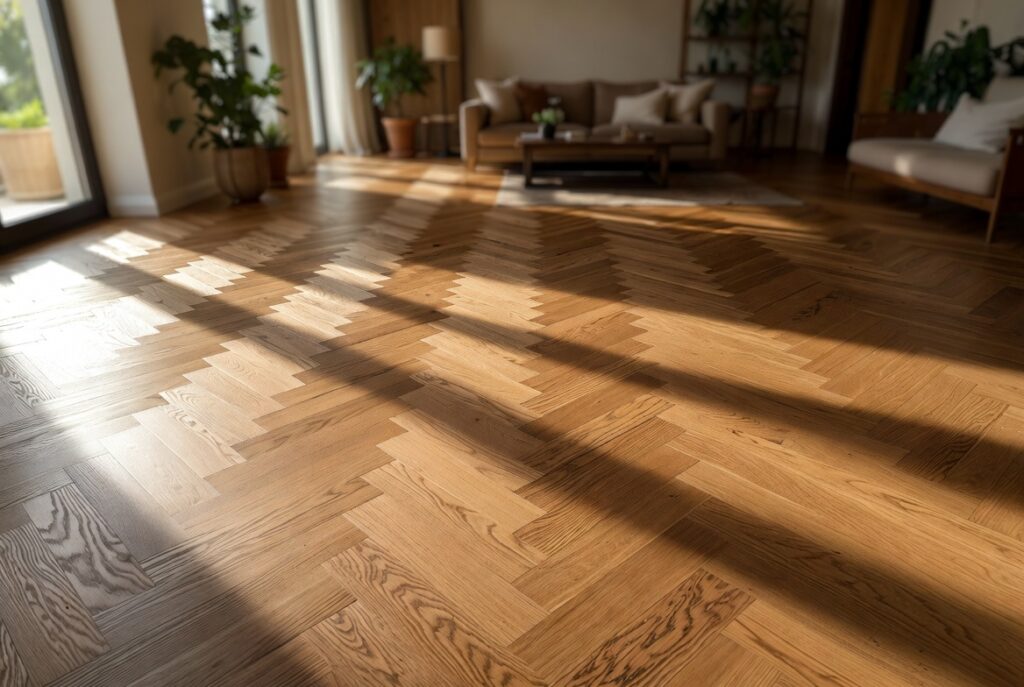
Most people know what herringbone looks like. That distinctive zigzag pattern on rectangular boards laid at angles to create a repeating V shape is something that has been used in European homes for centuries. Fewer people understand how the engineered construction alters the game compared to the traditional solid wood parquet version.
Traditional herringbone parquet flooring was made from solid wood blocks. Beautiful? yes. However, traditional the flooring was also expensive to source, difficult to lay, prone to movement in the UK’s damp climate, and essentially impossible to install over underfloor heating without significant risk. Furthermore, solid parquet required specialised fitters and tools. The cost added up quickly.
Herringbone engineered wood flooring solves most of these problems at once. The construction bonds a genuine oak top layer, which constitutes the part you see and touch, to multiple structural layers of timber beneath it. Because those layers run in different directions, the board becomes far more dimensionally stable than solid wood. It handles temperature changes and humidity fluctuations much better. Therefore, it’s suitable for rooms with underfloor heating, ground-floor installations, and the kind of open-plan living spaces that solid parquet would never have coped with.
The pattern is the same. The look is the same. The practical performance is considerably better.
Why Does the Pattern Actually Matter Beyond Aesthetics?
This is the question people think about but rarely find a direct answer to. Most articles just say herringbone “looks elegant” and move on. But there are genuinely functional reasons to choose the pattern beyond the visual appeal.
The diagonal orientation of herringbone boards creates a sense of movement across a room that straight planks simply don’t produce. More importantly, that diagonal draws the eye along the longest axis of the space rather than across the width. In a narrow hallway, which happens to be one of the most common places, people lay herringbone engineered wood flooring. This effect makes the space feel considerably longer and more generous than it actually is.
In an open-plan kitchen and living area, the pattern creates a natural visual anchor that gives the space definition without the need for rugs or furniture arrangements to break it up. It does the design work for you.
The Width Question Nobody Explains Properly
One of the most overlooked decisions when buying herringbone engineered wood flooring is board width. Most people pick a colour they like and move on. But width has a significant impact on how the finished floor looks in the room.
If you opt for the narrower boards, somewhere around 80mm wide, they create a finer, more intricate pattern with more visible zigzag lines per square metre. This suits smaller rooms, period properties, and spaces where you want the floor to feel detailed and traditional. The pattern is elegant and more decorative.
On the other hand, opting for wider boards ranging from 125mm to 150mm helps in creating a bolder, more open pattern with fewer lines per square metre. This suits larger rooms, contemporary interiors, and open-plan spaces where you want the herringbone effect without the floor feeling too busy or intricate.
The choice of width is therefore as important as the colour. Getting this right and matching the board width to the room size and the interior style is one of those decisions that separates a floor heavily from unplanned flooring.
Can You Actually Get Cheap Wood Flooring That Doesn’t Look or Feel Cheap?
Yes. But all you need to do is pay attention to the details and understand things.
The cheap wood flooring market has two very distinct tiers. The bottom tier is genuinely problematic, which consists of thin wear layers that can’t be sanded or refinished; core constructions that absorb moisture unpredictably; finishes that chip or dull within a couple of years; and boards that sound hollow underfoot because the construction isn’t dense enough to dampen sound properly.
However, the mid-range presents a completely different scenario. And in the UK market right now, genuinely excellent engineered flooring is available at prices that would have seemed impossible ten years ago. The key is knowing what to look for rather than just comparing prices per square meter.
What to Actually Check When Buying Cheap Wood Flooring
The wear layer thickness comes first. This is the real oak layer that affects the floor’s appearance and lifespan. Anything under 2.5mm is difficult or impossible to sand and refinish if the surface gets scratched or worn. A 3mm wear layer is a solid baseline. A 4mm wear layer gives you the option to sand and refinish the floor at least once or twice over its lifetime, significantly extending its useful life.
The core construction comes second. A multi-ply plywood core is generally preferable to HDF because plywood distributes stress more evenly and handles moisture fluctuations more predictably. Regardless of the price point, a product description that mentions multi-ply or plywood base construction is a positive indicator.
The finish type comes third. Lacquered finishes are tough, simple to clean, and require minimal maintenance, but they can look slightly more plastic in certain lighting conditions. UV oiled and natural oiled finishes look and feel more authentically like real wood, but they need occasional re-oiling to maintain their appearance. Neither is the best choice, and it all depends entirely on how much maintenance you’re willing to do and how the floor will look in your specific room’s lighting.
Summing Up
To sum up, conducting thorough and accurate research is essential before investing in engineered herringbone flooring. Yes, they are available at very affordable rates in the UK if only you buy them right from a reputed wholesale store, and they will get the flooring delivered directly at your doorstep in just a few days.